Case Study | Pressure Relief Analysis
AI-Accelerated Pressure Relief Analysis
A Gulf Coast gas plant revalidated all 15 protected systems 40% faster in comparison to a conventional study, with 100% API 521 scenario coverage. The study found 7 inadequate relief devices, and 5 of them failed on external fire cases the prior study never evaluated.
At a Glance
What’s covered
- The two documentation gaps that put PSM compliance at risk
- How the PRA-Agent and engineers split the work across five phases
- The 7 inadequate devices and what each one needs
- Results against Cognascents’ conventional project records
- Answers to common questions about AI-accelerated relief studies
The Challenge
A compliance requirement with a built-in tradeoff
Pressure relief analysis is not optional. For PSM-covered facilities, demonstrating that every protected system is safeguarded against credible overpressure is a regulatory requirement under OSHA Process Safety Management (29 CFR 1910.119) and EPA RMP rules. The relief design basis must reflect current operating conditions, not the conditions the unit was commissioned under. Two gaps recur across the facilities we serve, and both are compliance exposures:
Gap 1
No documented relief design basis
The protection may be physically adequate, but there is no current calculation record to prove it. In an audit or post-incident review, an undocumented basis is treated as no basis at all. In this particular case study, several of the 15 systems had no calculation record on file.
Gap 2
Outdated documentation
The study on file predates a process modification, feed change, debottleneck, or revamp, so the credited relief basis no longer matches how the unit runs. In this case study, the prior basis predated a significant process modification, and the fire case for the entire filtration section had never been evaluated.
The conventional approach forces a choice. Documentation (calculation packages, hydraulics, deficiency registers, and QA records) takes 30 to 40% of total study hours, and that competes directly with analysis time. Engineers either cut scenario scope to meet a deadline or extend the schedule to keep it. The study ends up thorough or timely, rarely both.
When the documentation burden is largely automated, engineer hours shift to what requires judgment: reviewing outputs, resolving data gaps, and making final technical determinations. Coverage is enforced by the methodology instead of compressed by the schedule.
The Approach
AI handles the volume. Engineers own the judgment.
Cognascents has an in-house, engineer-built pressure relief analysis agent, the PRA-Agent, that leverages a deterministic workflow of five phases (0 to 4). Each phase closes with an engineer approval gate and is followed by blocking QA checks. The agent does the production-volume work, and Cognascents engineers keep judgment, review authority, and accountability for every finding. The agent does not replace engineering judgment or take accountability for adequacy conclusions.
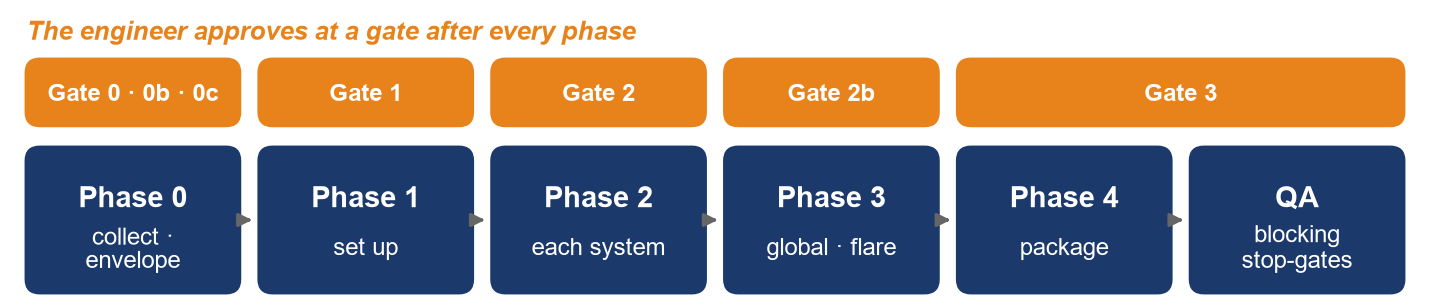
Data collection and protected envelope
The agent collects and classifies the source documents and defines the protected envelope for each device. The engineer approves the scope, the document catalog, and the envelope before analysis starts.
Project setup
The agent sets up the thermodynamic basis and calculation templates. Cognascents’ engineer approves both before any system is analyzed.
Per-system analysis
The agent answers every API 521 case for every system, calculates relief loads, and checks each installed device and its hydraulics. Cognascents’ engineer reviews the scenario register and adequacy findings, and applies judgment to borderline cases.
Global and flare analysis
The agent evaluates plant-wide scenarios and checks the flare and disposal network. Cognascents’ engineer reviews those findings and determines mitigation options.
Deliverables and QA
The agent compiles the study package and runs 26 automated QA stop-gates. Cognascents’ engineers perform the final QA/QC review and issue the study under engineer-of-record certification.
Get the full case study for the detailed agentic workflow.
Quality checks run before delivery
In conventional delivery, QA is a peer review after the work is done. Here, 67 engineering rules are enforced at calculation time, before a result is generated, and 26 automated stop-gates must pass before any deliverable is issued. Each gate is pass or fail, and the stop-gates are separate from the seven engineer approval gates that close each phase. If a required input is missing, the agent does not size the device. It logs a data gap and flags the item for an engineer to resolve.
Every output is fully reviewed and validated by a qualified Cognascents Engineer and every result carries its audit trail: source document revisions, API 520/521 citations with section and edition, the thermodynamic property basis, engineering rule citations, and the QA stop-gate record.
Key Findings
Seven inadequate devices, five from fire cases no one had run
Seven of the 15 devices evaluated needed an inadequacy finding. Five of the seven had never been evaluated against the external fire scenario in their prior calculation basis. One vessel’s fire case relief demand exceeded its installed capacity by more than 10×. It had been in service for years and looked adequate because no one had run the fire case. It was not missed because the original engineers were careless. The conventional methodology does not enforce 100% scenario review when the schedule does not allow it.
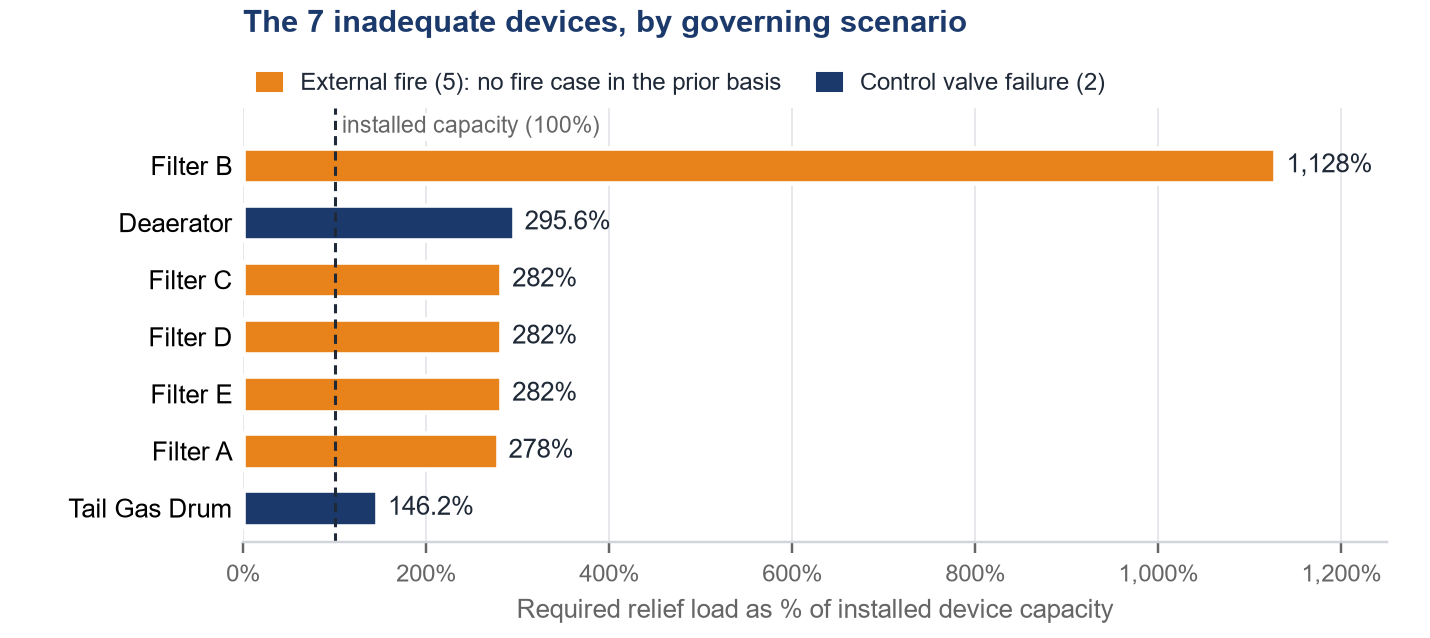
| Equipment | Governing Scenario | Utilization | Recommended Action |
|---|---|---|---|
| Deaerator | CV failure (steam) | 295.6% | Upsize to minimum N orifice (4.340 in²). Prior calculation contained an IEC metric/imperial unit error. |
| Tail Gas Drum | CV failure (gas) | 146.2% | Replace with minimum Q orifice (11.05 in²). Inlet piping re-evaluation required at Q capacity. |
| Filter A | External fire | 278% | Upsize device. Fire case basis was absent from the original calculation record. |
| Filter B | External fire | 1,128% | Fire case relief demand exceeds installed capacity by more than 10×. Upsize or add a supplemental device. |
| Filter C | External fire | 282% | Upsize device. Fire case basis absent from the original record. |
| Filter D | External fire | 282% | Upsize device. Fire case basis absent from the original record. |
| Filter E | External fire | 282% | Upsize device. Fire case basis absent from the original record. PSV not ASME VIII certified; data gap flagged. |
The table covers the 7 inadequacy findings. The study also documented 19 more deficiencies across the remaining systems, including backpressure exceedances, low-utilization chatter risks, non-ASME certifications, and data gaps to resolve before the study can be issued. All 26 deficiencies have specific recommendations, regulatory flag status, and a responsible party.
Results
About 40% faster, with every scenario covered
faster study completion.15 to 22 days vs. 10 days
API 521 cases evaluated for every system.100% coverage, no omissions
engineering rules enforced at calculation time.26 QA stop-gates before delivery
| Metric | Conventional Baseline | This Engagement | Outcome |
|---|---|---|---|
| Study cycle time, 15 systems | 15 to 22 days | 10 days | ~40% faster |
| Throughput | ~3 to 5 PSV systems per week (complex plant) | ~5 to 10 PSV systems per week | ~2× throughput for complex systems |
| QA gate | Post-delivery peer review | 26 automated stop-gates before delivery | Errors caught before delivery |
| Engineering rule enforcement | Peer review dependent, variable catch rate | 67 rules enforced at calculation time | Rules can’t be missed; errors flagged before results are generated |
| Documentation | 30 to 40% of study hours; variable revision cycles | Largely automated; citation-level traceability, first-issue deliverable | Engineer effort shifts to review and judgment, lowering billable hours per study |
| Data gap handling | Often undocumented or assumed away | Every gap logged with a specific recommendation | Defensible in a PSM audit; gaps are findings, not omissions |
| Schedule risk | High; long cycle competes with turnaround windows | Low | Fits inside MOC and turnaround planning, avoiding deferred startup or compliance findings |
Baselines come from Cognascents’ own conventional project records for the same scope of work. The figures are actuals from this engagement, not benchmarks or projections.
FAQ
AI-accelerated pressure relief analysis questions, answered
How long does an AI-accelerated pressure relief study take?
In this engagement, a 15-system Gulf Coast gas plant was revalidated in 10 days, compared with 15 to 22 days for Cognascents’ conventional projects of the same scope. The PRA-Agent screened all API 521 cases for every system, and engineers reviewed every finding before the study was issued.
Does AI replace the engineer of record in a pressure relief study?
No. The PRA-Agent handles screening, calculation, and documentation. Engineers confirm scope, validate governing cases, resolve data gaps, apply judgment to borderline cases, and run the final QA/QC review. Every study is issued under engineer-of-record certification, and the agent does not take accountability for relief adequacy conclusions.
Why can a relief device look compliant but still be undersized?
A prior study only protects the scenarios it evaluated. Here, five of the seven inadequate devices had never been checked against the external fire case, so they looked compliant on paper. A full API 521 review calculates every credible scenario for every system, which is how those gaps surfaced.
Get the Full Case Study
The complete pressure relief analysis case study, delivered to your inbox.
The full report adds the data fields evaluated for each scenario type, the lead engineer review triggers, the audit trail, and all 26 documented deficiencies.
405
Scenario evaluations
26
Deficiencies documented
Request This Case Study
Complete the form to receive the full case study directly to your inbox.
“We are not automating engineering. We are amplifying it, giving our engineers the reach, speed, and systematic coverage to do more of what only great engineers can do, on the schedule your operations actually require.”
Related Services
Services behind this work
Pressure Relief Analysis
Scenario evaluation, relief device sizing, and hydraulic assessment for PSM-covered facilities.
Flare System Design
Phase 3 of this study checked the flare and disposal network. Relief loads set flare header and tip sizing, so a changed device often means a flare system check is next.
Process Safety Information (PSI) Solutions
The missing and outdated calculation records this study closed are a PSI gap. We maintain relief design basis documents as part of ongoing PSI management.
References
Standards and sources
- OSHA, Process Safety Management of Highly Hazardous Chemicals, 29 CFR 1910.119.
- EPA, Risk Management Program (RMP) rule, 40 CFR Part 68.
- API Standard 520, Sizing, Selection, and Installation of Pressure-Relieving Devices.
- API Standard 521, Pressure-Relieving and Depressuring Systems.
- ASME Boiler and Pressure Vessel Code, Section VIII.
Next Step