Technical Blog
From an Auditor’s Perspective: Common Mechanical Integrity Gaps in PSM Audits
After participating numerous Process Safety Management (PSM) and Risk Management Program (RMP) compliance audits, you start to notice that Mechanical Integrity (MI) findings tend to look very similar from site to site. It doesn’t usually matter whether the facility is large or small, the same types of gaps come up repeatedly. The purpose of these audits isn’t to “catch” failures, but to identify areas where programs can be strengthened to better protect the integrity of equipment and prevent future incidents, while maintaining regulatory compliance. Most of the time, it’s not because the program doesn’t exist. In fact, many facilities have strong MI procedures on paper. The issue is usually consistency, tracking, or ownership over time.
Mechanical Integrity is one of those elements that requires constant attention, and when it drifts, auditors notice quickly.
One factor that often accelerates MI program drift, and doesn’t always get talked about enough, is personnel change. When experienced inspectors retire, engineers transfer roles, or maintenance supervisors rotate out, institutional knowledge can leave with them. Even if documentation exists, the practical understanding of how things actually run often isn’t fully captured.
During these transitions, inspection schedules may not get reassigned promptly, asset lists may not be reviewed, and ownership can become unclear. This is where small gaps begin to widen. Facilities that handle personnel changes well usually have strong handover processes, cross-training, and clearly documented responsibilities so the program doesn’t rely on any single individual.
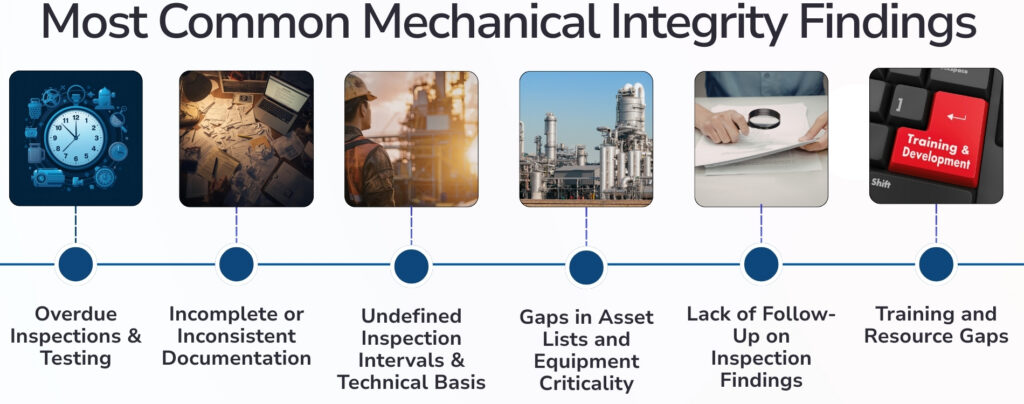
Common Finding: Overdue Inspections and Testing
The most common MI finding by far is overdue inspections and testing. This can include pressure vessels, piping circuits, storage tanks, relief valves, heat exchangers, or safety instrumented functions. In many cases, inspections were done regularly at one point, but schedules slowly slipped. Staffing changes, budget pressures, or manual tracking tools that stopped being updated are typical contributors.
Overdue inspections are highly visible in an audit because they are objective and easy to verify. There’s no gray area — a due date either passed or it didn’t.
The most effective way to prevent this issue is through strong digital tracking, typically via a Computerized Maintenance Management System (CMMS). Automated reminders, escalation alerts, and clearly assigned ownership significantly reduce missed deadlines. Tying responsibility to a role rather than an individual also makes personnel transitions easier to manage.
Common Finding: Incomplete or Inconsistent Inspection Documentation
Another frequent issue is incomplete or inconsistent inspection documentation. Sometimes the inspection occurred, but records are missing key details, stored across multiple systems, or not retained for the required period. Auditors want to see not just that work happened, but that it was documented clearly and can be retrieved easily.
This problem often becomes more pronounced after staffing changes, when new personnel don’t know where historical records are stored or what level of detail is expected.
Standardizing inspection templates and centralizing records helps eliminate this gap. Digital forms and mobile inspection tools reduce variability and make it easier to attach photos, measurements, and technician comments. Consistency in documentation is just as important as performing the inspection itself.
Common Finding: Undefined Inspection Intervals and Technical Basis
A common audit concern is the lack of a documented technical basis for inspection intervals. Facilities sometimes rely on historical practices rather than referencing industry standards such as American Petroleum Institute (API) or American Society of Mechanical Engineers (ASME). When asked why an inspection is scheduled at a certain frequency, the answer should be documented and defensible.
This gap often appears after experienced personnel leave and the reasoning behind interval decisions was never formally captured.
Establishing written inspection strategies and clearly linking intervals to recognized codes or risk-based approaches demonstrates technical grounding and audit readiness.
Common Finding: Gaps in Asset Lists and Equipment Criticality
Incomplete or outdated asset lists are another frequent finding. Some sites don’t have a clearly defined inventory of PSM-covered equipment, or the list hasn’t been updated in years. Equipment that isn’t on the list doesn’t get scheduled for inspection, creating compliance risk.
These gaps are especially common after organizational changes or capital projects where no one is explicitly responsible for validating the MI asset inventory.
Periodic asset verification, unit walkdowns, and tying asset creation to project close-out or Management of Change processes help keep the MI program complete and current.
Common Finding: Lack of Follow-Up on Inspection Findings
Inspections may identify corrosion, wall loss, or mechanical damage, but corrective actions are sometimes delayed or not formally tracked. From an auditor’s perspective, identifying an issue without closing it can be more concerning than missing the inspection entirely.
Personnel turnover can amplify this issue when action items are stored in personal files or emails rather than in a formal tracking system.
Formal action tracking with assigned owners, due dates, and verification of completion ensures findings don’t get lost and remain visible regardless of role changes.
Common Finding: Training and Resource Gaps
Auditors also frequently identify training and resourcing gaps. These can include inspectors without current certifications, unclear qualification requirements, or insufficient staffing to manage inspection workloads.
Maintaining a skills matrix, tracking certifications, and planning for workload coverage — especially during outages or personnel transitions — helps keep the MI program resilient.
Key Takeaway
Most Mechanical Integrity audit findings are not dramatic failures. They are signs of gradual drift — schedules slip, records scatter, asset lists age, and ownership becomes unclear, particularly during personnel changes.
Facilities that consistently perform well in MI audits focus on four fundamentals: consistent tracking, clear accountability, disciplined follow-up, and structured transition planning. When those elements are in place, audits shift from stressful events to routine confirmation that the system is working as intended.
Meet the Author
Diana Trevino – Senior Integrity Engineer

Diana holds a Master’s degree in Metallurgical and Materials Engineering and has more than 15 years of experience in metallurgy and mechanical integrity, primarily supporting facilities in the oil and gas and chemical industries. At Cognascents Consulting, she works with clients to develop, implement, and optimize Mechanical Integrity programs. Diana is also a member of Cognascents’ PSM and RMP Compliance Audit Team, where she brings deep technical expertise and an auditor’s perspective to the Mechanical Integrity element.
Related Cognascents Solutions
At Cognascents, we have the expertise to meet your needs. Explore the variety of related services we offer and discover how our tailored approach can support your business.
Our mission is to empower our clients with innovative solutions that enhance process safety, reliability, asset integrity, and technical business acumen. To elevate your engineering solutions, please contact us today.