Case Study
Refinery-Wide Integrity Operating Window Development
Client: Refinery | Location: Oklahoma, USA
Our client, a refinery operator, recognized the need to strengthen their mechanical integrity and corrosion management programs by formalizing the monitoring of key process variables that directly influence equipment degradation.
Within the process units, several challenges were noted, particularly with several sour water and amine systems operating without reliable tracking of critical parameters such as pH, temperature, and H₂S loading. The absence of defined control limits made it difficult to identify process upsets or trends that could significantly increase corrosion rates in carbon steel piping.
Although some corrosion control documentation existed, much of it was outdated, inconsistent, or incomplete, limiting its effectiveness in supporting proactive integrity management. Furthermore, the refinery lacked a structured system to identify, detect, and respond to process deviations that could accelerate corrosion, lead to premature equipment failure, or compromise overall asset reliability and safety.
Our Solution:
For each process unit included in the project scope, Damage Mechanism Reviews (DMRs), Corrosion Control Documents (CCDs), and Integrity Operating Windows (IOWs) were developed from the ground up.
The process began with gathering and validating all relevant design, inspection, and operating data, followed by the identification of corrosion loops and definition of credible damage mechanisms. Once these foundations were established, the IOWs were systematically developed to ensure alignment with unit-specific degradation risks and operating conditions.
In parallel, recommendations were formulated to guide inspection planning, including actions to be considered during inspections or incorporated into the site’s Inspection Management Plan, ensuring integration between process monitoring and mechanical integrity activities.
- Conducted DMRs to identify and validate anticipated degradation mechanisms for each asset in collaboration with site personnel.
- Developed CCDs summarizing how and why each asset experiences damage, and recommending actions to mitigate, monitor, and manage loss of containment risks
- Defined IOWs by evaluating process conditions, operating practices, equipment design, and historical data against the identified damage mechanisms.
- Facilitated IOW workshops with client representatives for each major process unit to validate proposed IOWs, confirm monitoring locations and frequencies, and establish clear roles and responsibilities for responding to excursions
- Implemented the IOW program within the client’s IDMS and process historian, enabling real-time monitoring, alerts, and continuous improvement of integrity management practices.
IOW Example:
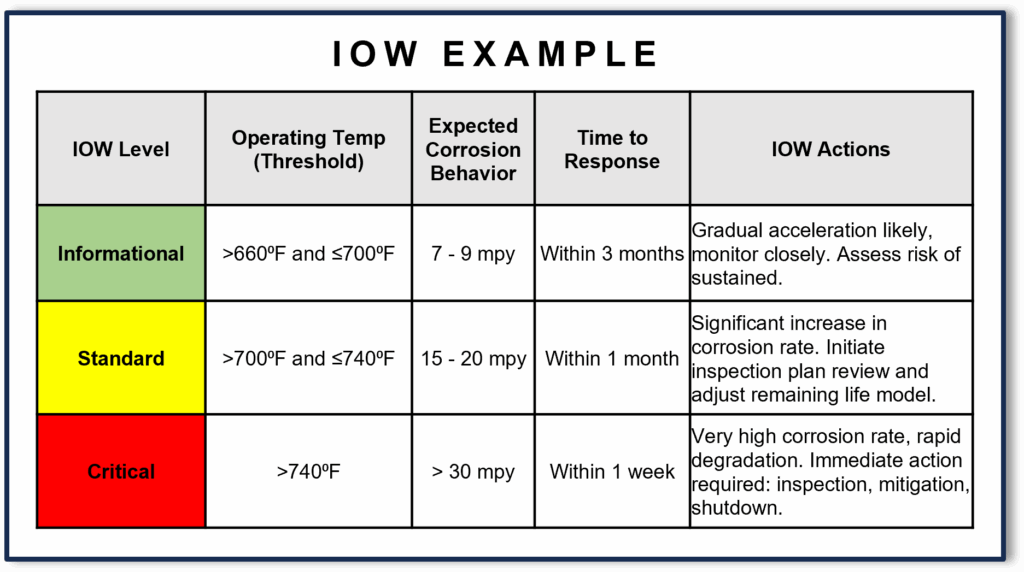
A set of IOWs was developed for every process unit. While the average unit required 10 to 15 IOWs, this number extended up to 40 for units of significant size and complexity.
This particular example is a simplified IOW for a section of process piping in a high-temperature hydroprocessing unit, focused on managing the risk of high-temperature sulfidation. This is just one of many IOWs developed for the unit, designed to address specific degradation mechanisms. While this example presents simplified IOW actions for clarity, note that the full IOW includes a complete breakdown of the IOW actions and developed key responsibilities, enabling effective implementation of the IOW
- Asset: Process piping in a high-temperature hydroprocessing unit
- Damage Mechanism: High-Temperature Sulfidation (> 450 °F)
- Monitored Parameter: Operating Temperature
- Material of construction: Carbon Steel
- Current Baseline Corrosion Rate: 5 mils per year (mpy)
- Remaining Life (based on baseline): 10 years
The Benefits
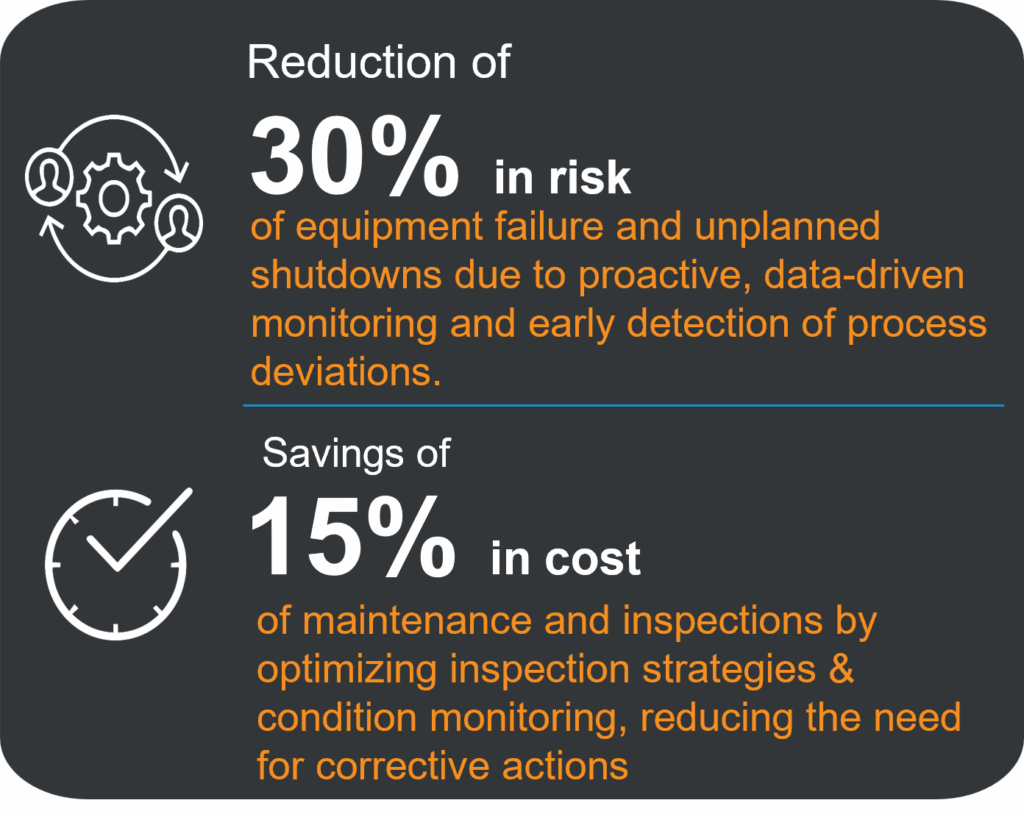
- Reduced operational and integrity risks: By mitigating IOW deviations, the refinery was able to minimize equipment failures, unplanned shutdowns, and safety incidents. Early detection of process upsets allowed for timely interventions, avoiding costly downtime and safety hazards.
- Increased inspection effectiveness: Leveraging Corrosion Control Documents (CCDs) enabled targeted inspections of high-risk areas, adjusting inspection frequencies based on real-time operational trends against the IOWs. This led to more efficient resource allocation and better alignment with risk.
- Enhanced decision-making: The use of defined IOWs empowered operators to make data-driven decisions when facing process deviations. This reduced the need for unnecessary shutdowns, helping to keep operations running smoothly and improve overall safety performance.
- Improved collaboration: IOW workshops and clear communication between operations, inspection, and maintenance teams helped align on goals, roles, and responsibilities, fostering a culture of proactive integrity management.
- Regulatory compliance: The IOWs also facilitated alignment with industry standards (e.g., API 570, 571, 581), ensuring compliance and supporting future audits and inspections.
Related Cognascents Solutions
At Cognascents, we have the expertise to meet your needs. Explore the variety of related services we offer and discover how our tailored approach can support your business.
Our mission is to empower our clients with innovative solutions that enhance process safety, reliability, asset integrity, and technical business acumen. To elevate your engineering solutions, please contact us today.